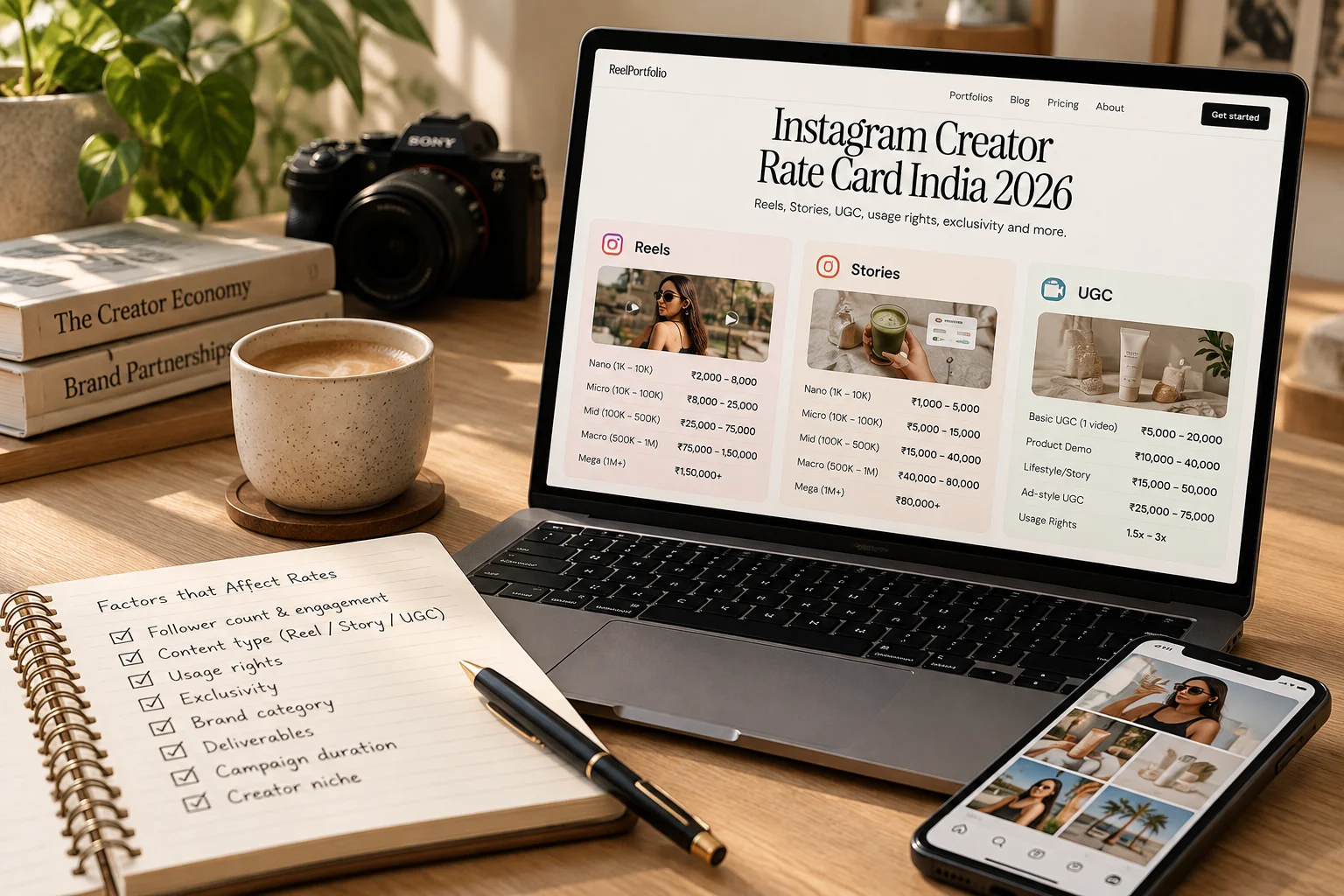
There is no universal influencer rate card for India. Broad 2026 market references put Instagram Reel pricing anywhere from the low thousands for nano creators to several lakhs for larger creators. But follower count alone does not determine the quote. Average views, audience relevance, niche, creative quality, production effort, usage rights, exclusivity and campaign requirements can all move the price.
Another creator's ₹20,000 Reel does not automatically mean you should charge ₹20,000. Their audience, views, niche, production process, demand, negotiation history and licensing terms may be completely different from yours. Use published numbers as benchmarks — not instructions.
Instagram influencer rates in India: 2026 benchmark
Current Indian pricing sources disagree on exact rates. That disagreement is important: it tells you that influencer pricing is a market, not a fixed menu.
The table below is therefore a deliberately broad synthesis of multiple 2026 Indian pricing references. It is intended to show the order of magnitude of common quotes, not what every creator in a follower tier should charge.
| Creator tier | Typical audience | Reel benchmark | Story / set benchmark | Important context |
|---|---|---|---|---|
| Nano | 1K–10K | ₹1.5K–₹10K | ₹300–₹6K | Local, niche and community-led creators can quote very differently from one another. |
| Micro | 10K–100K | ₹7K–₹50K | ₹1.5K–₹20K | Large variation depending on views, niche and creator demand. |
| Mid-tier | 100K–500K | ₹40K–₹2.5L | ₹15K–₹80K | Production value, audience quality and campaign scale become increasingly important. |
| Macro | 500K–1M | ₹1.5L–₹6L | ₹50K–₹2.5L | Many campaigns are negotiated individually rather than from a public rate card. |
| Mega / celebrity | 1M+ | Custom | Custom | Rates can depend on talent, campaign prominence, exclusivity, production and media rights. |
These are broad benchmark bands synthesized from multiple 2026 Indian market references, including current creator marketplaces and industry pricing guides. They are not guaranteed prices, settled-invoice averages or a universal industry tariff.
Why influencer rates are not fixed
Search “influencer rates India” and you can find wildly different numbers for the same follower tier. That is not necessarily because one source is wrong.
A rate card becomes misleading when it removes the variables surrounding the number.
For example, two creators could both have 50,000 Instagram followers:
- Creator A averages 8,000 Reel views.
- Creator B averages 150,000 Reel views.
- Creator A makes general lifestyle content.
- Creator B specializes in a high-intent commercial niche.
- Creator A delivers simple talking-head content.
- Creator B produces scripted, edited, product-focused videos.
There is no obvious reason those creators must charge the same amount simply because the follower number looks identical.
“How many followers do I need before I can charge ₹X?” There is no follower threshold that guarantees a particular price. Your content, audience and commercial value matter too.
10 things that can change your creator rate
Average views
A brand may care more about the attention your content actually receives than the number printed beside your Instagram profile.
Audience relevance
An audience concentrated in the brand's target market can make a creator more relevant even when another creator has a larger following.
Niche
Finance, technology, beauty, automotive, B2B, education and other specialist categories can have different commercial demand from broad entertainment or lifestyle content.
Engagement quality
Comments, saves, shares and the quality of audience interaction can provide more context than follower count alone.
Production effort
Scriptwriting, locations, models, props, editing, voiceover, multiple hooks and additional filming all increase the work involved.
Brand demand
A creator receiving regular enquiries in a niche can have different pricing power from someone with similar metrics but much lower commercial demand.
Turnaround
A campaign requiring delivery tomorrow is different from one giving you two weeks to create, review and deliver.
Revision requirements
Unlimited revisions create an unpredictable workload. Define what is included before agreeing to the fee.
Usage rights
Organic posting and giving a brand permission to use your content in paid advertising are different commercial rights.
Exclusivity
If you cannot work with competing brands for a period of time, that restriction has commercial value and should be priced.
How much should you charge for an Instagram Reel?
Reels are often the most complex Instagram deliverable because they can require concept development, scripting, filming, editing, captions, product integration and revisions.
Current 2026 Indian pricing references place Reel rates across very wide bands. One current creator marketplace, for example, reports a median listed Reel price of ₹4,200 across a relatively small live sample, while broader industry guides publish much wider ranges across follower tiers. These should not be treated as contradictory facts about a single “correct” price; they are different samples and methodologies.
A useful question is therefore not:
“What does a 40K creator charge?”
Ask instead:
“What should a creator with my average views, audience, niche, production effort and rights package charge?”
A Reel quote should answer these questions
- Is the creator posting the Reel on their account?
- Is the brand supplying a script or is the creator developing the concept?
- How many products are included?
- How many revisions are included?
- Is raw footage being delivered?
- Can the brand use the Reel as an advertisement?
- For how long?
- Is category exclusivity required?
Instagram Story rates in India
Stories are often priced differently from Reels because the production burden and lifespan are different.
But “one Story” is ambiguous.
A single photo frame with a link is not the same deliverable as a five-frame Story sequence involving talking-to-camera footage, product demonstration, captions and a CTA.
Define the Story deliverable
- Number of frames
- Photo or video
- Talking-to-camera requirement
- Link sticker / CTA
- Poll / question / interaction
- Product demonstration
- Reshoots and revisions
A reasonable rate card should therefore avoid simply saying “Story — ₹X”.
It is clearer to say something like: Story Frame , 3-Frame Story Set , or 5-Frame Story Campaign .
UGC creator rates in India
Influencer content and UGC are not priced in exactly the same way. Influencer campaigns can include distribution to the creator's audience. UGC is often purchased primarily as a content asset that the brand can use on its own channels or in advertising.
That means follower count may be much less important for a UGC creator than the creator's ability to produce the requested asset.
Current 2026 Indian UGC references show standard videos ranging from a few thousand rupees to considerably higher prices depending on production, experience, specialist positioning and rights.
A beginner creating a simple 15–30 second testimonial should not automatically use the same rate as a creator producing a complex multi-hook advertising asset with raw footage, revisions, paid-media licensing and exclusivity.
Price the UGC asset separately from the rights
This distinction is one of the most important ideas in this entire article.
You are potentially selling two things:
- The creation of the content.
- The permission to use that content.
Usage rights can change the quote dramatically
Imagine a brand asks:
“Can we also use this Reel as a paid advertisement?”
That is not necessarily a small wording change. The original deal may have been for creation and organic posting. Paid advertising introduces a different commercial use.
Current Indian UGC pricing references commonly treat paid-ad licensing, whitelisting and longer-term usage as separate add-ons rather than automatically including them in the base content fee. :contentReference[oaicite:2]{index=2}
Brand posts the content on its own organic social channels within the agreed campaign scope.
Brand uses the content in Meta, Google or other paid campaigns. Define duration and platforms.
Advertising may run using the creator's identity or handle, depending on the platform and arrangement.
Content may appear on a brand website, product page or marketplace listing.
You agree not to work with competing brands for a defined period.
The brand requests unusually broad or indefinite rights. Read this carefully before accepting.
How much extra should you charge for usage rights?
There is no single universal percentage. Current 2026 pricing guides commonly show paid usage and whitelisting attracting meaningful premiums over the base creation fee, with longer or broader rights attracting larger premiums. Exact percentages vary considerably by creator, campaign and licensing scope.
Instead of blindly memorizing “add 50%”, define the actual licence:
- Which platform?
- Organic or paid?
- How many countries?
- How many days or months?
- Can the brand edit the asset?
- Can the brand sublicense it?
- Can the brand use your face indefinitely?
Once the rights are clear, the fee becomes easier to justify.
Should you price by followers or views?
Followers are easy to see, which is why they became the industry's simplest shorthand. But they are an imperfect pricing variable.
A practical internal benchmark is to track your recent content performance, especially your median or average views across a meaningful sample of posts, rather than anchoring your entire quote to your follower count.
This is a pricing framework, not a universal industry formula. Your own historic deals and workload should gradually become more important than generic internet benchmarks.
How to calculate your own creator rate
Start with your minimum acceptable economics.
Step 1: Calculate the work involved
Estimate how much actual work the campaign requires:
- Brief review
- Concept development
- Scriptwriting
- Filming
- Editing
- Communication
- Revisions
- Uploading / reporting
Step 2: Account for production costs
Include genuine out-of-pocket costs such as travel, locations, props, equipment rental, models or specialist production.
Step 3: Add the value of your audience
If you are posting to your own audience, you are not only creating a file. You are also distributing it to an audience you spent time building.
Step 4: Price the rights separately
Do not automatically give a brand twelve months of paid usage because they asked for “content”.
Step 5: Price restrictions
Exclusivity can prevent you from taking other work. A restriction that costs you future revenue should not silently disappear inside your base rate.
A practical example
Imagine a fictional creator receives this brief:
- One Instagram Reel
- Creator develops the concept
- Product demonstration
- One revision round
- Organic posting only
- Seven-day turnaround
The creator could quote a single production + posting fee. Now change just one part of the brief:
- Brand wants six months of paid advertising rights.
The quote should change because the commercial scope changed.
Change it again:
- Brand wants six months of paid advertising rights
- Creator-handle advertising / whitelisting
- Category exclusivity for three months
That is now a substantially different package even though the creator still films only one Reel.
How to build your own rate card
Your rate card should not be a random list of numbers pulled from Google.
Build it around the actual services you sell.
Your services
- Instagram Reel — organic posting
- Instagram Story — single frame
- Instagram Story — 3-frame set
- Instagram Story — 5-frame set
- UGC video — 15–30 seconds
- UGC video — 30–60 seconds
- Product photography
- Additional revision
- Raw footage delivery
- Paid advertising usage
- Whitelisting
- Category exclusivity
What should you put on your public rate card?
You do not necessarily need to publish every number publicly.
Some creators prefer:
- Public “starting from” prices
- A private detailed rate card
- Custom quotes based on campaign scope
- Packages for common deliverables
A private rate card can give you more flexibility because a campaign involving three Reels, Stories and a licensing package is not necessarily best priced by simply adding three public menu items together.
When should you raise your rates?
Do not wait for a magical follower milestone.
Revisit your pricing when the underlying economics change.
- Your average views have increased materially.
- Your audience has become more commercially relevant.
- Your niche has stronger brand demand.
- Your content quality has improved.
- Your production process takes more time.
- You are consistently receiving more enquiries than you can comfortably accept.
- Your previous rates are no longer covering the workload.
Conversely, a larger follower count does not automatically justify a larger rate if your recent content performance, audience relevance or commercial demand has moved in the opposite direction.
When should you offer a discount?
Discounts can make sense when you are receiving something valuable in return.
Examples:
- Multiple deliverables in the same production session
- A genuine long-term partnership
- Reduced production complexity
- Guaranteed volume
- Flexible timeline
Avoid giving a permanent discount simply because the brand says “this is our budget”.
Instead, change the scope.
“At ₹15,000 I can deliver one Reel with organic usage. For the additional paid usage you requested, the revised quote would be ₹X.”
8 influencer pricing mistakes to avoid
1. Pricing entirely from follower count
Followers are a useful reference point, not a complete pricing model.
2. Copying another creator
Their deal terms may be completely different from yours.
3. Giving away usage rights
“The brand wants to use it” is not enough. Ask where, how and for how long.
4. Including unlimited revisions
Define the number of revision rounds.
5. Forgetting rush fees
A compressed deadline changes your workload.
6. Treating every Story as the same
One frame and a five-frame campaign are different deliverables.
7. Quoting before understanding the brief
Ask about deliverables, timeline, usage and exclusivity first.
8. Publishing unsubstantiated results
Only claim campaign results and performance numbers that you can actually support.
What about barter collaborations?
Product-only collaborations are common in the creator market, especially among smaller creators and early-stage campaigns.
But “free product” is still compensation in some regulatory and disclosure contexts. ASCI states that disclosure is required when there is a material connection between a brand and influencer, including situations involving monetary or other benefits such as free or discounted products. :contentReference[oaicite:3]{index=3}
On the commercial side, decide whether the product itself is genuinely worth accepting in exchange for the requested work. A ₹2,000 product should not automatically buy a creator's entire production process, posting rights and advertising licence.
What about taxes, invoices and contracts?
Pricing is only one part of professional creator work.
Depending on your business structure, turnover, registration status and the nature of the transaction, GST, tax withholding, invoices and other compliance requirements may apply. These are legal and tax questions rather than pricing rules, so confirm the treatment applicable to your own setup with a qualified professional.
More importantly, put the commercial scope in writing.
- Deliverables
- Timeline
- Revision limit
- Payment terms
- Usage rights
- Exclusivity
- Cancellation terms
The creator rate card you should actually build
Base creation fee
— what it costs to make and publish the work.
Usage fee
— what the brand pays to use it beyond the agreed organic
placement.
Production add-ons
— travel, additional filming, models, locations, raw footage,
rush delivery, etc.
Exclusivity
— compensation for restricting competing work.
Your rate card is a starting point, not a prison
This is the part many new creators miss.
A rate card is not supposed to eliminate negotiation. It is supposed to give you a professional starting position.
You may quote differently for:
- A startup running its first campaign
- A large consumer brand
- A long-term ambassador relationship
- A campaign requiring paid media
- A product category you strongly specialize in
- A campaign with heavy production requirements
The important thing is knowing why your number changed.
Don't send brands a spreadsheet of screenshots.
ReelPortfolio puts your content, audience, performance, collaborations, services and professional information behind one shareable creator link.
Create your ReelPortfolio →Frequently asked questions
How much should an influencer charge for a Reel in India?
There is no single fixed rate. Broad 2026 market benchmarks span roughly ₹1,500–₹10,000 for nano creators, ₹7,000–₹50,000 for many micro creators, ₹40,000–₹2.5 lakh for mid-tier creators and ₹1.5 lakh–₹6 lakh for many macro creators. Actual pricing depends on audience quality, average views, niche, creative effort, rights and demand.
How much should Indian creators charge for Instagram Stories?
Story pricing depends on the number of frames and campaign complexity. A single Story frame is a different product from a three- or five-frame Story sequence. Broad 2026 references range from hundreds or low thousands for smaller creators to much higher amounts for larger creators.
How much do UGC creators charge in India?
UGC is typically priced by the content asset rather than follower count. Current 2026 references commonly show pricing from a few thousand rupees for straightforward creator-produced assets into the tens of thousands or more when production complexity, specialist positioning and licensing increase.
Should influencer rates be based on follower count?
Follower count can be one input, but it should not be the entire pricing model. Average views, audience relevance, niche, engagement quality, production and licensing can all materially affect the quote.
Should creators charge extra for usage rights?
Usage rights should be considered separately from the base creation fee. Paid advertising, whitelisting, extended licensing, website use and exclusivity can require additional fees depending on the scope and duration.
Can two creators with the same follower count charge different rates?
Yes. Their audience, average views, niche, content quality, campaign history, demand and licensing terms may be very different.
Should creators copy another influencer's rate card?
No. Other creators' rates are useful as reference points, but your own pricing should reflect your workload, audience, positioning, demand and rights.
Do creators need to disclose paid collaborations in India?
Creators should follow applicable disclosure rules. ASCI's influencer advertising guidelines require clear disclosure when there is a material connection between a brand and influencer, including certain monetary, gifted or incentivised relationships.
Research & sources
This article intentionally combines multiple current references rather than reproducing a single publisher's rate card.
- Kofluence — Decoding Influence 2026 — current Indian influencer marketing research using first-party platform data, creator surveys and expert interviews.
- InfluencerMetric — Instagram Collaboration Rates in India — current marketplace-listed pricing data with sample-size limitations explicitly noted.
- CollabScene — Influencer Rates in India 2026 — broad Indian campaign pricing benchmarks.
- The UGC Agency — UGC Content Pricing India 2026 — UGC-specific pricing and licensing variables.
- InfluencerMetric — UGC Usage Rights in India — licensing, paid ads, whitelisting and exclusivity.
- ASCI — Influencer Advertising Guidelines FAQs — disclosure requirements for influencer advertising.
- Meta — Creator Marketplace and Partnership Ads — how brands and creators can collaborate through Instagram's creator ecosystem.
Pricing changes over time. ReelPortfolio should review this article periodically and update the benchmark section rather than allowing a 2026 rate table to remain indefinitely.