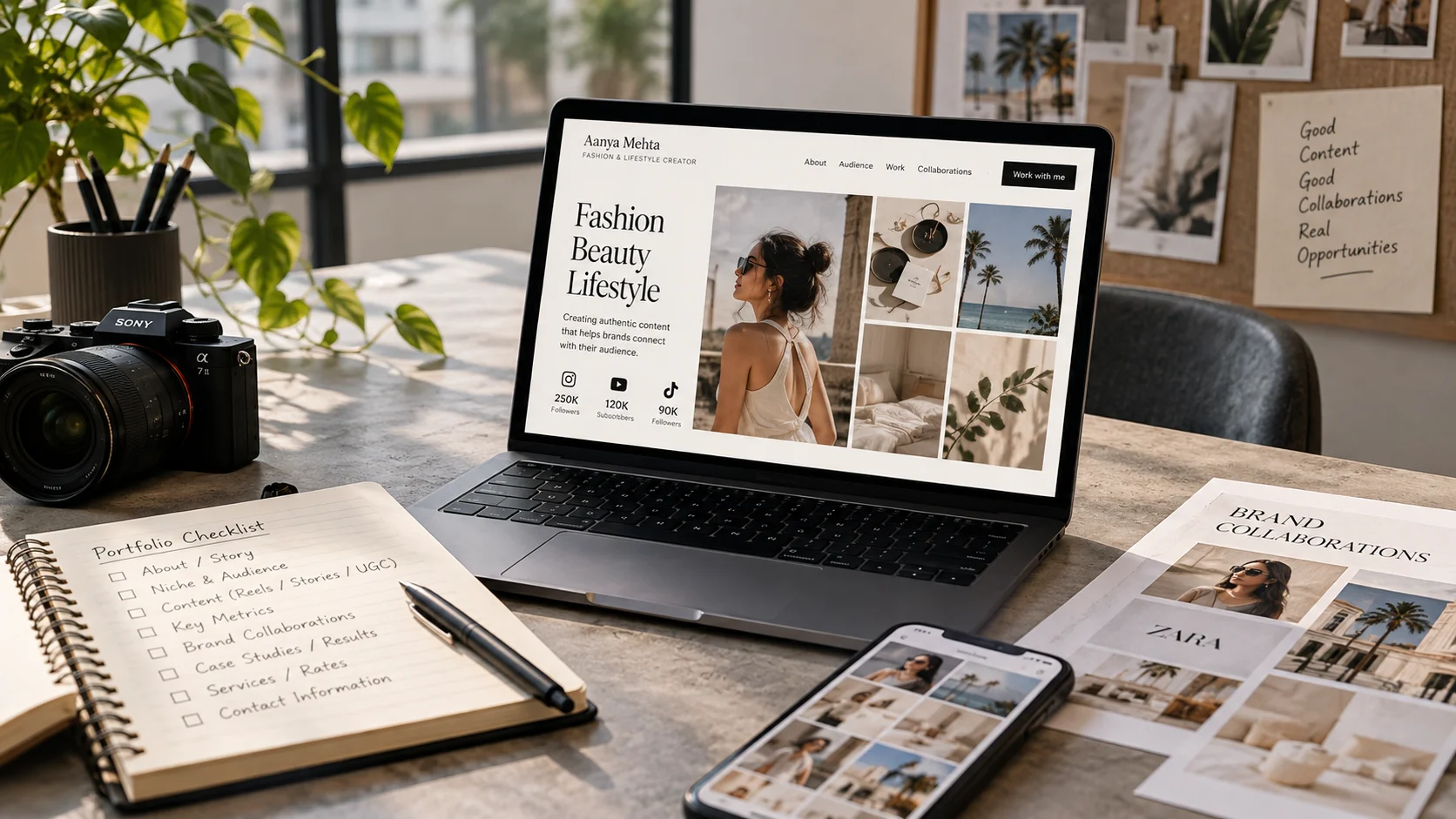
A creator portfolio for brands should include your creator introduction, niche, audience information, relevant performance metrics, best content, previous collaborations, campaign results, services and an easy way to contact you. The portfolio should make it possible for a brand to understand your value without having to search through your Instagram profile.
What is a creator portfolio?
A creator portfolio is a professional online space that presents your work, audience and experience to potential brand partners.
Your Instagram profile is where you publish content. Your creator portfolio is where you can organize and explain that work.
This distinction matters because a brand evaluating a creator usually needs more information than a social media feed can conveniently provide.
The job of your portfolio is simple: help a brand understand who you are, what you create, who you reach and what you can deliver.
What do brands look for in a creator portfolio?
A brand does not necessarily need every possible statistic. It needs relevant information that helps evaluate whether your content and audience fit the campaign.
Your portfolio should make these questions easy to answer:
9 things to include in your creator portfolio
1. Your creator introduction
Start with the information that immediately identifies you.
Include your name, creator title, location and a short description of what you create.
Niharika Sharma
— Fashion & Lifestyle Creator
Mumbai · 58K followers
I create fashion, styling and lifestyle content focused on
wearable looks, seasonal trends and everyday inspiration.
Avoid turning your introduction into a biography. A brand should understand your positioning within a few seconds.
2. Your niche and content categories
Clearly define the areas you create content around.
For example:
- Fashion
- Beauty
- Skincare
- Fitness
- Food
- Travel
- Finance
- Technology
- Lifestyle
- UGC
If you work across multiple categories, keep the list focused. Three clear categories are generally easier to understand than ten unrelated ones.
3. Audience information
Your audience is one of the most important parts of your creator profile.
Depending on what information you have available, you can include:
- Top audience locations
- Age ranges
- Gender distribution
- Audience interests
- Relevant geographic markets
Do not publish every private Instagram insight simply because you have access to it. Include the information that actually helps a brand understand your audience.
4. Relevant performance metrics
Numbers can provide useful context, but more numbers do not automatically make a portfolio stronger.
Focus on metrics that help demonstrate content performance.
Other useful metrics can include reach, saves, average views and campaign-specific results.
Avoid presenting numbers without context. If a metric relates to a specific campaign or piece of content, explain that.
5. Your best content
Your portfolio should show your work rather than simply describe it.
Select content that represents the kind of work you want to get hired for.
For example, a beauty creator could showcase:
- Product demonstration
- Skincare routine
- Before-and-after content
- Educational Reel
- UGC product video
Quality and relevance matter more than simply displaying a large number of posts.
6. Previous brand collaborations
If you have worked with brands, show relevant collaborations prominently.
You can include brand names, campaign objectives, deliverables and the type of content you created.
Skincare Launch Campaign
Created short-form educational content for a new skincare product launch.
- 2 Instagram Reels
- 3 Instagram Stories
- Product-focused storytelling
- Campaign content optimized for awareness
7. Campaign results and case studies
A collaboration becomes more useful as portfolio evidence when you explain what happened beyond the deliverables.
A simple case study can follow this structure:
- Objective: What was the campaign trying to achieve?
- Approach: How did you create the content?
- Deliverables: What did you produce?
- Impact: What measurable results can you substantiate?
This is often more informative than simply displaying a row of brand logos.
8. Your services
Tell brands what they can actually hire you for.
- Instagram Reels
- Instagram Stories
- UGC videos
- Product photography
- Event content
- Long-term partnerships
- Content licensing
You can include starting prices if they fit your commercial strategy. Alternatively, invite brands to enquire for a campaign-specific quote.
9. A clear contact option
Do not make a brand search for your email address.
Your portfolio should have an obvious next step such as:
Interested in working together?
Email: hello@example.com
Or use the enquiry form to share your campaign brief.
What should a creator portfolio NOT include?
A common mistake is treating the portfolio as a storage location for everything you have ever created.
Consider removing:
- Old content that no longer represents your work
- Irrelevant statistics
- Long personal biographies
- Unrelated collaborations
- Unverified performance claims
- Too many screenshots of Instagram Insights
The portfolio should feel curated. A brand should be able to understand your positioning without digging through dozens of unrelated sections.
Should a creator portfolio show follower count?
Yes, if it is relevant — but follower count should not be the only number on your portfolio.
A creator with 20,000 followers and highly relevant content may be more useful for a particular campaign than a creator with a substantially larger audience that does not match the campaign's target audience.
Your portfolio should therefore give enough context for a brand to understand both the size and relevance of your audience.
What if you have never worked with a brand?
You can still create a creator portfolio.
New creators can use their strongest original content, UGC samples, product demonstrations, photography and concept campaigns to demonstrate what they can produce.
Be transparent about what is actual client work and what is self-created or sample work. Do not present hypothetical campaign results as real results.
6 common creator portfolio mistakes
1. Making the portfolio look like another Instagram feed
A portfolio should organize information that Instagram does not present particularly well for professional evaluation.
2. Showing too much work
Ten strong examples are generally more useful than fifty average ones.
3. Using only vanity metrics
Followers are easy to understand, but they do not provide enough context on their own.
4. Hiding the creator's niche
A brand should not have to guess what type of creator you are.
5. Making case studies too vague
Explain the objective, approach, deliverables and measurable outcome where available.
6. No obvious contact method
The portfolio should make the next step obvious.
Creator portfolio checklist
Before sharing your portfolio with brands, check that it contains the following:
Turn your content into a professional portfolio.
ReelPortfolio gives creators one shareable link for showcasing content, audience information, collaborations, campaign results and services.
Create your ReelPortfolio →Frequently asked questions
What should a creator portfolio include?
A creator portfolio should include your introduction, niche, audience information, relevant performance metrics, best content, previous collaborations, campaign results, services and contact information.
What do brands look for in a creator portfolio?
Brands need enough information to understand your content style, audience relevance, previous work, performance and available collaboration services.
Do creators need a portfolio if they already have Instagram?
Instagram can show your content, but a dedicated portfolio can organize your work, audience information, campaign results and services specifically for professional evaluation.
Should a creator portfolio include follower count?
Follower count can be included, but it should not be the only performance metric. Views, reach, engagement and audience information can provide additional context.
Can a new creator have a portfolio without brand collaborations?
Yes. New creators can use original content, UGC examples, sample campaigns and other relevant work to demonstrate their content quality and capabilities.